
Sarah booked a full detail on her Volvo XC60 and was told to expect about three and a half hours. She handed over the keys, stepped inside, and came back to a car that looked genuinely different. What she didn’t see was everything that happened in between.
Most people know detailing takes longer than a car wash, but few understand why. The difference isn’t just effort. It’s a sequence of specific steps that build on each other, and skipping or rushing any one of them changes the quality of the final result. This is the detailing process explained from start to finish: what each stage involves, why it matters, and what’s actually happening to your vehicle the whole time.
For a full look at what’s included in each of Halo’s service packages, the Nashville car detailing services page breaks it down by package level.
Key Takeaways
Here’s a brief overview of what we’ll cover:
- The Process Has a Specific Order: Each stage prepares the surface for the next one. Washing before decontamination, decontamination before correction, correction before protection. The sequence matters.
- Preparation Takes the Most Time: The majority of a professional detail is spent on cleaning, decontamination, and correction before any protection goes on. This is where the time and skill investment lives.
- Correction Is the Most Technical Stage: Machine polishing removes defects from your clear coat through controlled abrasion. It requires trained technique and proper equipment to do safely.
- Protection Is the Payoff: Whether wax, sealant, or ceramic coating, protection applied to properly prepared paint bonds better and lasts significantly longer.
- Interior and Exterior Often Happen in Parallel: On a full detail, two technicians often work simultaneously, which is why a comprehensive service can still be completed in a few hours.
Get in touch at 615-815-8291 if you’d like to know which stages apply to your specific service before booking.
Why Order Matters
A professional detail isn’t a list of tasks done in any order. It’s a sequence where each step sets up the next one. Applying protection before decontamination seals contaminants under a coating. Polishing before washing reintroduces abrasive particles to paint you just corrected. Cleaning interior surfaces before extracting carpet means dirty water runs back onto what you just cleaned.
Understanding the logic behind the order makes the time investment make sense. Here’s how a full detail actually unfolds.
Stage 1: Pre-Wash and Foam Bath
The first thing that happens is a pre-rinse to remove loose surface debris. Grit, dirt, and pollen sitting on the paint will scratch if dragged across the surface during washing. Getting them off before any physical contact happens protects the paint from the start.
After the rinse, a foam cannon coats the entire vehicle in a thick layer of pH-neutral soap. The foam clings to vertical surfaces and dwells for several minutes, softening and loosening bonded contamination before a wash mitt touches the paint. This step reduces friction during the hand wash and makes the cleaning stage significantly safer for the clear coat.
Wheels, wheel wells, and door jambs get separate attention at this stage. These areas carry the heaviest contamination, including brake dust and road grime, and are cleaned with dedicated products and separate tools to avoid cross-contaminating the painted surfaces.
Stage 2: Hand Wash and Rinse
After the foam dwell, the vehicle is hand-washed using the two-bucket method. One bucket holds clean soapy water, the other holds clean rinse water for the mitt between passes. This keeps abrasive particles from the vehicle’s surface from being dragged back across the paint on the next pass.
The detailer works top to bottom, panel by panel, rinsing each section before moving to the next. After the full wash, a thorough rinse removes all soap residue. Then the vehicle is dried using clean, plush microfiber towels rather than left to air dry. Water allowed to evaporate on the paint leaves mineral deposits, especially in Nashville where water hardness varies by area and season.
Stage 3: Decontamination
This is the step most people don’t know exists, and it’s one of the more important ones.
Washing removes loose contamination from the surface. Decontamination removes bonded contamination that washing can’t reach. Even a freshly washed car carries embedded particles you can’t see: iron deposits from brake dust, industrial fallout, tar from road surfaces, and mineral buildup from water exposure. Run your fingers across a washed panel and if it feels slightly rough or textured, that’s contamination bonded to the clear coat.
A chemical decontamination spray is applied first. Iron removers react with metal particles embedded in the paint, causing a colour change as the product dissolves them. After chemical decon, a clay bar is worked across wet paint in straight passes, physically pulling bonded particles out of the clear coat. The result is paint that feels completely smooth to the touch, which is the baseline the next stages need.
Decontamination is included in Halo’s premium detail package and is always performed before any ceramic coating installation.
Stage 4: Paint Correction
Not every service includes full correction, but for vehicles with swirl marks, water spot etching, fine scratches, or oxidation, this is where the most significant transformation happens.
Paint correction uses a machine polisher with appropriate pads and compounds to remove a controlled amount of the clear coat’s outer layer, eliminating the defects that live within it. Single-stage correction handles light imperfections. Multi-stage correction works through progressively finer compounds to address deeper damage before finishing to a high gloss.
This stage requires proper lighting to see defects accurately, precise technique to avoid burning through the clear coat, and enough time to work each panel systematically. Rushing it produces uneven results or, in the worst case, damage to the paint. On a vehicle with moderate swirl marks, correction alone can take two to four hours.
For a deeper look at what correction addresses and where its limits are, the guide on what detailing can’t fix covers the distinction between correctable and non-correctable damage.
Stage 5: Protection Application
After the paint is clean, decontaminated, and corrected, protection goes on. This is the stage that determines how long the results last and how well the paint holds up between services.
Wax and paint sealant are applied by hand or with a machine applicator, allowed to cure briefly, and then removed with a clean microfiber. These products bond to the clear coat and create a sacrificial layer that absorbs environmental wear so the paint doesn’t have to. Wax lasts around two to three months. A quality sealant runs three to five months.
Ceramic coating is a different category. Applied in thin, even layers to properly prepared paint, it bonds chemically to the clear coat and cures into a semi-permanent protective film. The coating lasts one to five years depending on the product tier. It also needs to cure in a dust-free environment for at least 24 hours, which is why ceramic coating work is typically scheduled as a separate appointment from a standard detail.
Protection applied to clean, decontaminated, corrected paint bonds more effectively and lasts longer than the same product applied to unprepared paint. The earlier stages aren’t just cleaning. They’re setting up this one.
Stage 6: Interior Detailing
On a full detail, interior work often happens in parallel with exterior stages. While the exterior foam is dwelling or the paint correction is underway on one section, a second technician works through the interior.
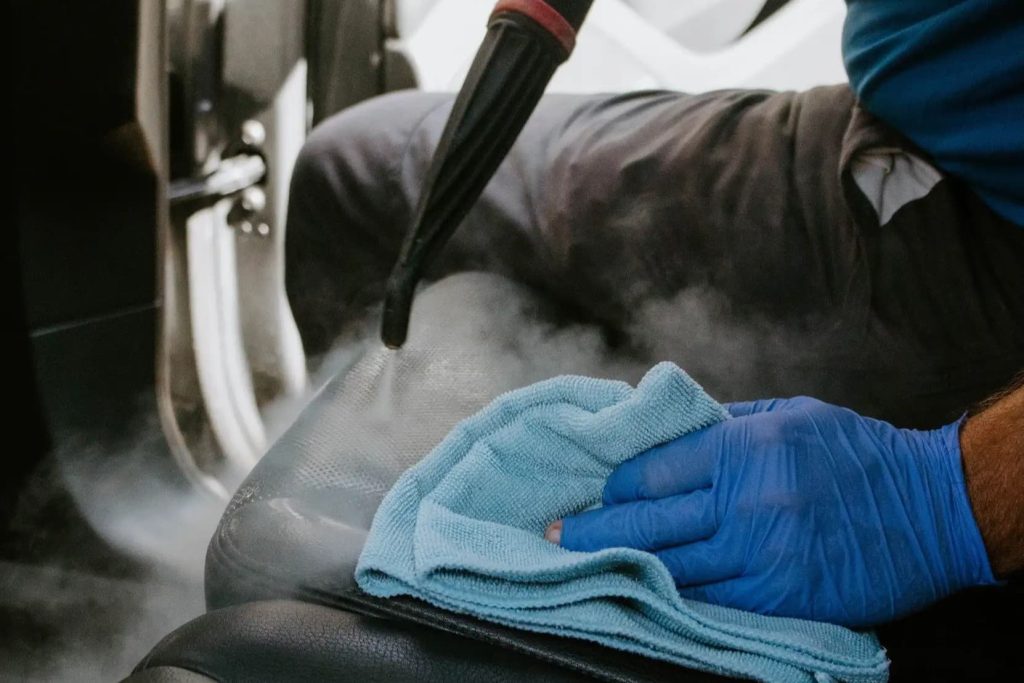
The interior process starts with a thorough vacuum of all surfaces including under seats, in seat crevices, and in the trunk. Then extraction cleaning uses heated solution injected into carpet fibers and upholstery, pulling embedded dirt, oils, and bacteria back out. This is what separates professional interior cleaning from what a home vacuum can accomplish.
Hard surfaces, the dashboard, door panels, centre console, and trim, are cleaned with appropriate products and wiped down. Leather seats are cleaned and conditioned. Interior glass is cleaned with automotive cleaner applied to a microfiber rather than sprayed directly onto surfaces, which prevents overspray on the dashboard. Door jambs, often missed in a basic wash, get wiped down and protected.
A thorough interior detail through Halo’s interior service typically takes 90 minutes to two and a half hours depending on vehicle size and condition.
Stage 7: Final Inspection and Walkthrough
The last stage is a systematic check of every surface before the keys go back to the owner. Paint is examined under different lighting angles for any missed areas or uneven protection application. Interior surfaces get a final pass for anything overlooked. Glass is checked for streaks. Tires are dressed, door jambs are wiped, and any product residue in gaps or trim edges is cleaned out.
At Halo, we walk the vehicle with the customer at the end of the service and point out what was done and what we noticed during the work. If there’s paint damage beyond what detailing can address, or wear in the interior that cleaning didn’t fully resolve, we flag it at this stage.
Ready to book? Get in touch at 615-815-8291 or schedule your appointment online and we’ll match the right service to your vehicle’s current condition.
FAQs for the Detailing Process Explained
Why does a full detail take three to five hours?
The time comes from the number of stages and the care required at each one. Pre-wash, foam bath, hand wash, decontamination, correction, protection, and a full interior service each take significant time to do properly. Rushing any stage produces inferior results or risks damaging the paint.
Is paint correction included in every detail?
No. Light polishing is included in the premium package. Full single or multi-stage correction is a separate service based on your vehicle’s paint condition. We assess the paint before recommending correction.
What’s the difference between decontamination and washing?
Washing removes loose surface dirt. Decontamination removes bonded contamination, like iron deposits and road tar, that washing can’t reach. Decontamination leaves the paint smooth and properly prepared for polishing and protection.
Do I need to do anything to prepare my car before a detail?
Remove personal belongings from the interior, especially the seats, trunk, and floor areas. A basic pre-wash isn’t necessary since the detailer handles that as the first stage. Let us know in advance about any specific concerns like paint chips, recent bodywork, or aftermarket film.
How long should I wait before washing my car after a detail?
After a standard wax or sealant service, wait at least 24 hours before washing. After ceramic coating, wait five to seven days to allow full cure. Washing too soon can disrupt the bonding process and reduce how long the protection lasts.