
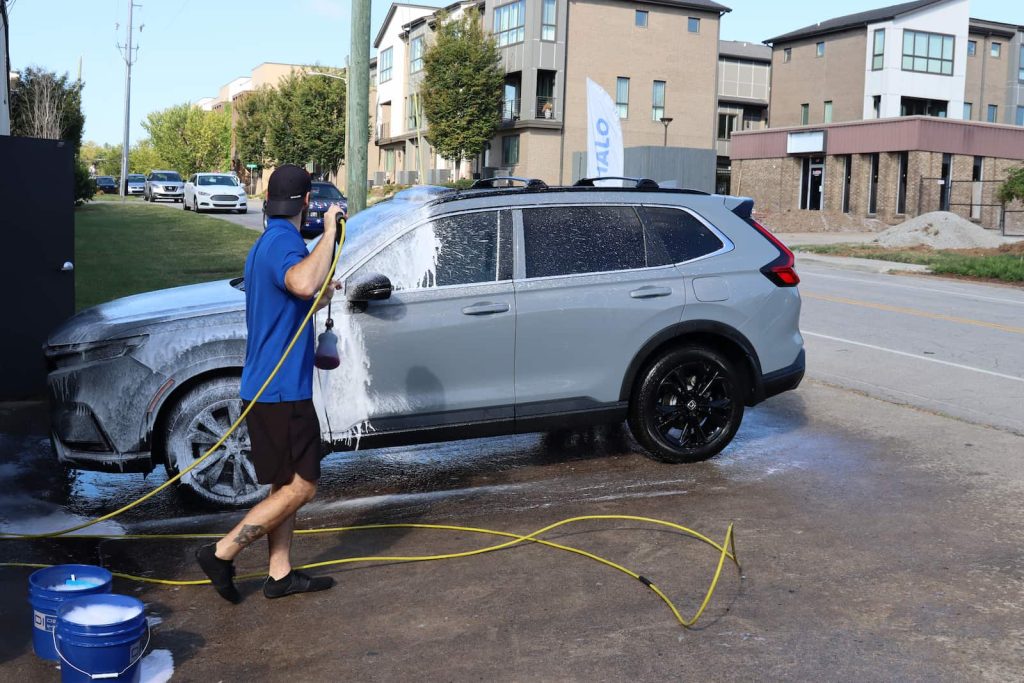
Marcus parked his dark green Highlander in his East Nashville driveway on a Saturday morning, garden hose in hand. He wanted to knock out a wash before the afternoon heat. He figured he was being responsible by doing it himself. After about twenty minutes of rinsing, soaping, scrubbing, and rinsing again, his driveway ran gray with soapy runoff. The car looked decent. What he did not know was the cost. He had just used somewhere between 80 and 140 gallons of water. Most of it carried soap, oil, and brake dust straight into the storm drain at the end of his street. Mobile detailing water use tells a very different story.
A professional mobile detail of that same vehicle would have used 3 to 5 gallons. That is not a rounding error. The gap comes down to technique, chemistry, and purpose-built products that do more with less. To see why those numbers sit so far apart, our mobile detailing environmental benefits breakdown covers the full picture. And if you want to know how the service works from start to finish, what to expect during a mobile detail walks through each step.
Key Takeaways
Mobile detailing water use: A professional mobile detail typically uses 3 to 5 gallons per vehicle, versus 80 to 140 for a home wash.
Tunnel car wash consumption: Tunnel washes without reclamation use roughly 65 to 85 gallons of fresh water per vehicle, per EPA WaterSense data.
Why home washing uses so much: A garden hose flows at 8 to 10 gallons per minute, so even a 10-minute rinse adds up fast before soaping and rinsing twice.
Rinseless chemistry changes the math: Rinseless and waterless products encapsulate dirt and lift it away without a full-water rinse, so large volumes are unnecessary.
Runoff is the other half: Home washing sends contaminated water into storm drains untreated. Proper mobile technique minimizes runoff and keeps pollutants out of waterways.
Nashville conditions make this relevant: Between spring pollen, summer humidity, and fall debris, cars need frequent attention, and lower water use makes that more sustainable.
Mobile Detailing Water Use: Where the Numbers Come From
The figures come from EPA research, not marketing. The EPA WaterSense at Work program studied vehicle washing across facility types. Conveyor tunnel systems without reclamation use about 65.8 gallons per vehicle for friction washes and around 85.3 gallons for frictionless ones. Reclamation systems cut those numbers a lot, but most basic tunnels do not use reclamation. Home washing has no ceiling at all, because it depends entirely on how long the hose runs.
Mobile detailing sits in a different category, because the delivery method is different. A trained detailer does not flood the car and rinse over and over. Instead, they apply a rinseless wash solution to a panel, agitate it gently with a microfiber mitt, and lift it away with a clean towel. The product does the heavy lifting, not water volume. A good mobile setup carries a small tank of clean water for the moments a rinse genuinely helps. But the default approach uses far less than any hose-based method.
How Does Rinseless Washing Actually Work?
Rinseless washing uses concentrated chemistry to encapsulate dirt particles. The particles bind to the wash media instead of scratching the paint during removal. The detailer dilutes the product, loads a microfiber mitt, works one panel at a time, and removes the solution with a separate dry microfiber. The process is methodical and panel by panel. That makes it safer than hosing a whole car down and hoping the water carries debris away cleanly.
This matters beyond water savings. Dragging loose dirt across paint without enough lubrication is how swirl marks happen. Rinseless chemistry adds enough lubrication in the wash media to move contamination off the surface without grinding it in. The result is a cleaner car and a lower risk of fine scratches. For coated or corrected paint, that is not a minor detail. HALO is a FEYNLAB Approved Installer. Ceramic coatings installed under that certification are designed to release contamination more easily during maintenance washes, which makes rinseless technique even more effective on coated vehicles. You can read more in our ceramic coating maintenance Nashville guide.
Is Washing at Home Really That Much Worse?
Home washing uses more water, makes more runoff, and sends that runoff straight into storm drains with no treatment. A standard residential hose runs at 8 to 10 gallons per minute. A thorough home wash takes at least 10 to 15 minutes of actual water flow. That is before you count the people who let the hose run between steps. EPA research confirms that efficient professional systems beat home washing on water use, even without advanced reclamation.
Runoff compounds the problem. Soap, road grime, brake dust, and oil all wash off during a home wash and travel to storm drains. Most residential areas do not filter street-level runoff before it reaches local waterways. Mobile detailing limits this by using less water and by applying products in a controlled way. That reduces what leaves the vehicle’s surface in liquid form. It matters near Nashville’s waterways and neighborhoods, where storm-drain awareness counts. Our environmental impact of car washes post covers the full breakdown.
Does Less Water Mean a Less Thorough Clean?
Less water does not mean less clean. The confusion comes from mixing up water volume with cleaning power. Water is a delivery method and a rinse agent, nothing more. Detailing chemistry is built to do with a little diluted solution what a garden hose tries to do with volume. When a detailer works a rinseless product into a panel correctly and removes it with a properly loaded microfiber, the panel comes out cleaner than most home washes manage.
Some situations do call for a full rinse. Heavy contamination, dried mud, or winter road salt buildup are good examples. A good mobile detailer knows when to use more water and when the standard approach is enough. The goal is never to shortchange the job. It is to use exactly what the job requires. Nashville winters can leave salt and grime on undercarriages and lower panels that benefit from a real flush. For that seasonal context, our winter car detailing Nashville guide goes deeper.
What About Nashville’s Pollen Season?
Take someone like Jennifer, who parks her white Volvo under a mature oak in Green Hills. By mid-April, that car wears a layer of yellow-green pollen by nine in the morning, two days after a wash. It is a normal spring reality for Nashville drivers. The temptation is to wash harder, more often, and with more pressure to blast it off.
The smarter approach is more frequent gentle washes with rinseless technique. It protects paint from the repeated contact marring that aggressive washing causes, and it keeps water use per session low. Vehicles with a FEYNLAB ceramic coating from a certified applicator have a real edge here. Pollen releases more easily from a properly coated surface, so the maintenance wash takes less time and effort. Vehicles with no protection need more caution, because pollen can be acidic and abrasive when worked into the paint during drying or wiping. Our Nashville pollen season car care guide covers timing and approach for getting through spring without damaging your paint.
Frequently Asked Questions
Do mobile detailers bring their own water?
Yes. HALO Mobile Detailing arrives with everything needed to complete the job, including water, power, and all professional equipment and products. No hookup to a customer’s outdoor spigot is required, though it is available as a backup when the job calls for more water than the tank carries.
How does mobile detailing use so little water compared to a car wash?
Mobile detailing relies on rinseless and waterless chemistry that encapsulates dirt and allows it to be lifted away with microfiber without a large volume of rinse water. A standard tunnel car wash uses water as both the cleaning agent and the rinse mechanism, which requires much higher volumes. Professional mobile products are concentrated and purpose-built to do more work with less water.
Is the rinseless wash method safe for all paint types?
Rinseless washing is safe for all standard paint finishes, including clear coats, coated surfaces, and factory paint, when performed by a trained detailer using properly loaded microfiber and correct technique. Matte and satin finishes require specific products designed for those surfaces. HALO adjusts approach based on the finish type before starting any exterior service.
Does HALO use eco-friendly products beyond just low water use?
Water conservation is one component of a broader approach. The products used in professional mobile detailing are selected for cleaning performance and for minimizing environmental impact in terms of runoff content and biodegradability. Using less water also means less contaminated runoff leaving the vehicle’s surface and entering local storm systems.
How often should I have my car detailed in Nashville given the pollen and climate?
Most Nashville vehicles benefit from a maintenance wash every two to four weeks, with a more thorough detail two to four times per year depending on usage, parking conditions, and how much the owner cares about the finish. During heavy pollen months, more frequent light washes protect the paint better than infrequent heavy scrubs.
If you want professional results without wasting water or your afternoon, book a mobile detail with HALO. The Express Detail starts at $150, and our team comes to your home or office in Nashville, Brentwood, Franklin, Green Hills, Belle Meade, and surrounding areas. Call 615-815-8291 or book your appointment online to get on the schedule.