
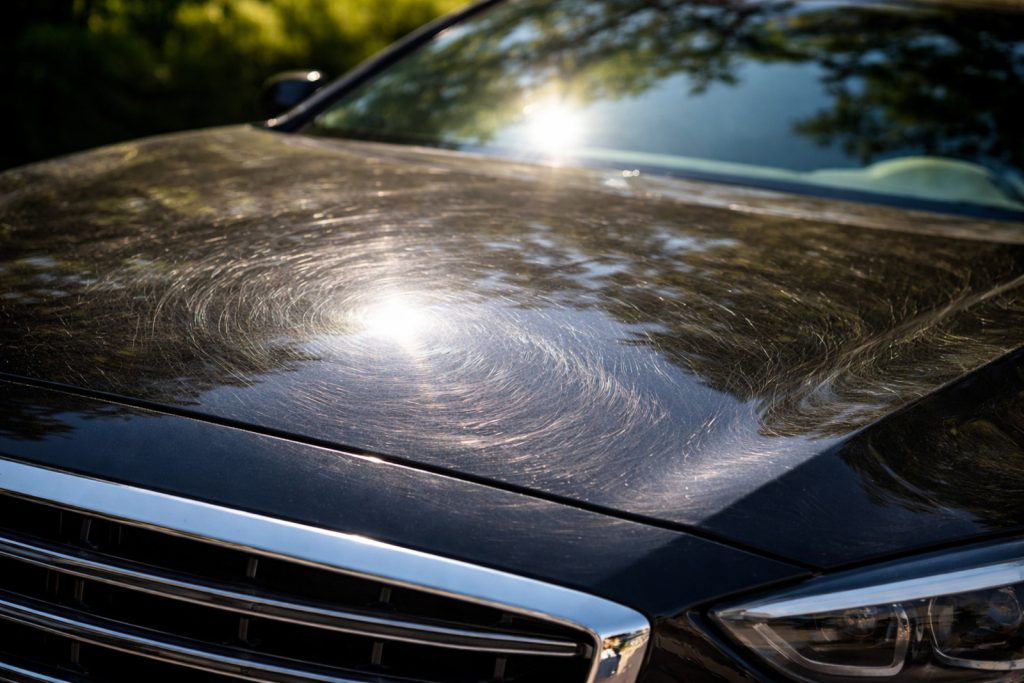
Kevin brought his Lexus ES to us convinced he needed major paint work. He pointed at circular patterns covering his hood and called them deep scratches from a parking lot incident. A quick inspection showed standard swirl marks from years of automatic car washes. His paint needed light polishing, not the extensive correction he feared.
The confusion between swirl marks and scratches costs Nashville drivers money. Some pay for aggressive correction when light polishing would solve the problem. Others ignore genuine scratches assuming they match the swirl marks covering the rest of their car. At Halo Mobile Detailing, we assess paint damage on vehicles across Belle Meade, Green Hills, Brentwood, and Franklin before recommending any correction level.
Understanding the difference helps you communicate accurately with detailers and evaluate whether quotes match your actual needs. The distinction comes down to depth, cause, and what removal requires.
Key Takeaways
- Swirl marks are microscopic circular scratches in clear coat caused by improper washing, visible as spider web patterns under direct light but too shallow to feel with your fingernail.
- True scratches penetrate deeper into clear coat or through to base coat, often appearing as single lines you can feel when running your finger across the surface.
- Swirl marks respond to single-stage polishing costing $300 to $500, while deep scratches may require multi-stage correction at $800 to $1,200 or touch-up paint for base coat damage.
- Nashville automatic car washes cause most swirl marks locally, with the rotating brushes creating characteristic circular patterns across horizontal surfaces.
- Proper identification prevents overpaying for unnecessary correction and ensures real damage receives appropriate treatment.
Call us at 615-815-8291 to get an accurate assessment of your paint damage and appropriate correction recommendations.
What Swirl Marks Actually Are
Swirl marks are thousands of microscopic scratches in your clear coat arranged in circular or random patterns. Each individual scratch measures fractions of a millimeter deep. Grouped together, they scatter light in ways that create the spider web or hologram effect you see under direct sunlight or parking lot lights.
The circular pattern comes from the motion that created them. Rotary buffers used incorrectly leave circular swirls. Automatic car wash brushes spinning against your paint create arcs matching their rotation. Hand washing with dirty towels produces random patterns following your wiping motion.
Swirl marks live entirely within your clear coat layer. They do not penetrate to base coat or primer. This shallow depth means polishing can remove them completely without risking your paint system. The process removes a thin layer of clear coat until the scratched surface disappears, leaving smooth clear coat beneath.
Every vehicle develops swirl marks over time. Dark colors show them dramatically. Black, dark blue, and deep red paint reveals swirls that white and silver cars hide completely. The swirls exist on light-colored paint too. You simply cannot see them without intense inspection lighting.
What True Scratches Look Like
Scratches differ from swirl marks in depth, pattern, and cause. A scratch typically appears as a single line rather than grouped circular marks. You can often trace the scratch path and identify a specific incident that caused it.
The fingernail test provides quick assessment. Run your fingernail perpendicular across the mark. If your nail catches in a groove, you have a scratch deep enough to feel. Swirl marks never catch your fingernail because they lack sufficient depth.
Scratches happen from contact with harder objects. Key marks from vandalism. Shopping cart scrapes in parking lots. Branch contact from tight driveways. Belt buckle rubs when leaning against your car. Each incident leaves a distinct line rather than the distributed pattern of wash-induced swirls.
Scratch depth determines treatment options. Surface scratches staying within clear coat respond to polishing like swirl marks, just requiring more aggressive cutting. Scratches reaching base coat show the underlying paint color in the groove. Scratches through base coat to primer appear white or gray. Scratches to bare metal show silver.
How Nashville Driving Creates Both
Nashville conditions generate both types of damage through predictable patterns.
Automatic car washes cause most local swirl marks. The spinning brushes carry grit from previous vehicles and grind it against your paint with each pass. A single automatic wash adds thousands of microscopic scratches. Weekly visits compound the damage dramatically. After a year of automatic washes, even new paint shows significant swirling.
The tunnel washes along major corridors including West End, Franklin Road, and Nolensville Pike see heavy traffic. Brushes accumulate debris from hundreds of daily vehicles. The convenience costs your paint clarity over time.
Parking lot incidents create most Nashville scratches. Crowded lots at Green Hills Mall, CoolSprings Galleria, and downtown parking garages put vehicles in close proximity. Shopping carts, car doors, and tight maneuvering produce contact scratches. The scratch often goes unnoticed until you wash your car and see the mark in clean paint.
Construction zones add another scratch source. Loose gravel, debris from trucks, and tight lane closures create opportunities for contact damage. The I-440 reconstruction and ongoing development projects across Williamson County put commuters near construction vehicles daily.
Identifying Your Damage Correctly
Accurate identification starts with proper lighting. Direct sunlight works best for revealing swirl marks. Position yourself so the sun reflects off the panel surface at a low angle. Swirl patterns appear as interconnected circles or spider webs across the paint.
For scratches, look for distinct lines that cross through the swirl pattern rather than following it. Scratches stand out because they differ from surrounding damage in direction and intensity. A key scratch across a swirled door shows clearly as a single line cutting through circular marks.
The fingernail test confirms depth. Gently drag your nail across suspected scratches. Surface damage too shallow to feel responds well to polishing. Damage deep enough to catch your nail requires more aggressive correction or may exceed what polishing can address.
Color in the damage tells you depth. Clear coat scratches show no color change in the groove. They simply look like lines because they scatter light differently. Base coat scratches reveal the paint color beneath your clear coat. Primer scratches appear white or light gray. Metal scratches show silver and require immediate attention to prevent rust.
What Each Type Requires for Removal
Swirl mark removal uses single-stage polishing in most cases. A light cutting compound removes the top layer of clear coat containing the scratches. Finishing polish refines the surface to high gloss. The process takes 4 to 6 hours for a complete vehicle and costs $300 to $500 depending on vehicle size.
Single-stage work addresses moderate swirling on daily drivers and removes the worst visibility while maintaining reasonable paint correction cost. Most Nashville vehicles benefit from this level after a few years of automatic wash use.
Deep swirl marks or dark colors needing perfect results require two-stage correction. The first stage uses aggressive cutting compound. The second stage removes marks left by stage one while maximizing gloss. Time increases to 8 to 12 hours with cost running $500 to $800.
Clear coat scratches respond to the same polishing process but may need more aggressive compounds or additional passes over the affected area. Spot correction of individual scratches costs less than full-vehicle polishing when damage stays localized.
Base coat and deeper scratches cannot be polished out completely. Polishing can soften their appearance by rounding sharp edges and reducing visibility. Complete removal requires touch-up paint to fill the groove before polishing levels the surface. Severe scratches to primer or metal need professional paint repair beyond detailing scope.
Preventing Future Damage
Hand washing eliminates the primary swirl mark source. Using proper technique with clean microfiber towels, grit guards, and quality soap prevents the friction damage automatic washes cause. The time investment pays returns in paint clarity over years.
Ceramic coating adds scratch resistance that reduces new damage accumulation. Coated paint still swirls from aggressive contact but resists light friction that would mark unprotected clear coat. The harder surface provides meaningful protection for daily drivers.
Parking awareness reduces scratch incidents. Choosing end spots away from cart returns, avoiding tight spaces next to large vehicles, and parking farther from entrances all reduce contact risk. The extra walking prevents repair bills.
Getting Paint Assessment from Halo
We evaluate paint damage before recommending correction levels. Call us at 615-815-8291 or book online to schedule an assessment.
Our inspection identifies swirl marks, scratches, and other defects across your vehicle. We explain what each type of damage requires and provide honest recommendations including cases where full correction costs more than the improvement justifies. Our detailing packages include options for vehicles at every condition level.
FAQs About Swirl Marks and Scratches
Can swirl marks turn into scratches over time?
Swirl marks do not deepen into scratches through aging or exposure. They remain at their original shallow depth indefinitely. New damage from contact incidents creates scratches independent of existing swirl marks. The two damage types have different causes and do not interact.
Do swirl marks affect paint protection or just appearance?
Swirl marks create only cosmetic issues. The microscopic scratches scatter light but do not compromise clear coat protection of base coat beneath. Your paint remains sealed despite visible swirling. Appearance suffers but function continues normally.
Will wax or sealant fill in swirl marks?
Wax and sealant temporarily reduce swirl visibility by filling microscopic valleys with product. The marks return when product wears away, typically within weeks. These products mask rather than remove swirl marks. Only polishing provides permanent correction.
How do I know if a scratch is too deep to polish?
Scratches showing white, gray, or silver coloring have reached primer or metal and cannot be polished out. Scratches catching your fingernail aggressively likely penetrate too deep for complete removal. Professional assessment with proper lighting determines exactly what polishing can achieve for your specific damage.
Should I correct swirl marks before selling my car?
Paint correction before sale improves presentation and can increase offers by more than the correction cost on vehicles where paint condition affects value. A $400 correction on a $30,000 vehicle often returns $800 to $1,500 in sale price. Economy vehicles see less return because buyers focus more on mechanical condition than paint clarity.