
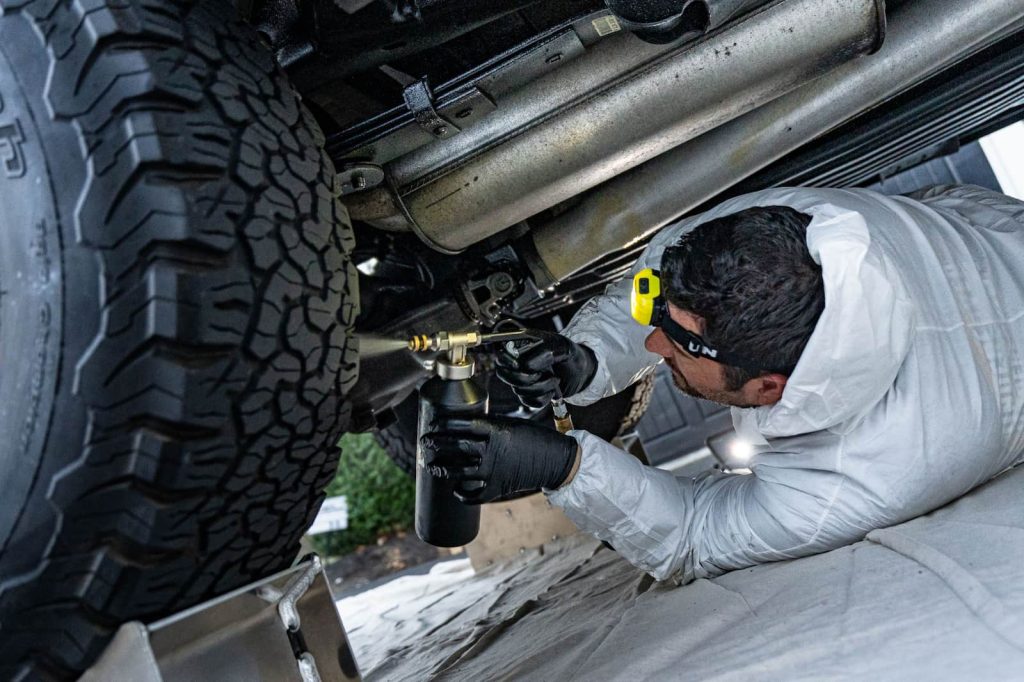
Tom bought a used pickup that spent its early life up north. When he had it on a lift, he noticed a dusting of surface rust along the frame rails. He asked us a simple question. Is there anything that stops this from getting worse? Here is the direct answer. Undercoating is a protective coating for the underside of your vehicle. It shields the frame, brake lines, fuel tank, and fasteners from rust and corrosion. For Nashville drivers, it is worth considering mainly because of the road salt Tennessee spreads during winter storms. That salt is one of the fastest ways to start corrosion on an exposed undercarriage.
Undercoating is a different category from the paint-focused detailing most people picture. It addresses a part of the car most owners never see. The undercarriage takes the worst of the road: salt, moisture, gravel, and grime. It also has far less factory protection than the painted body panels. A quality undercoating adds a durable barrier that keeps corrosion from taking hold. HALO now offers this as a dedicated service through UnderCover UnderCoaters. Learn more on our Undercoating Service page. Our post on road salt damage in Nashville explains why the local winter matters more than people expect.
Let me explain what undercoating actually is, the product we use, and how to know whether your vehicle needs it.
Key Takeaways
Undercoating protects the underside: It coats the frame, brake lines, fuel tank, and fasteners that road salt and moisture attack first.
Nashville winters are the reason: TDOT crews use calcium chloride and magnesium chloride on winter roads, and those salts accelerate rust on bare metal.
UnderCover UnderCoaters by HALO uses lanolin WoolWax: Our undercoating is a naturally derived sheep’s wool grease product that stays flexible, self-heals minor scratches, and never fully dries.
It lasts two to three years: Lanolin undercoating outlasts oil-based products that need annual reapplication, and it works on any vehicle from sedans to heavy-duty trucks.
Trucks and kept vehicles benefit most: Owners who plan to keep a vehicle long term, and truck owners especially, get the clearest value.
To ask whether undercoating makes sense for your vehicle, reach out through HALO’s contact page or call 615-815-8291.
What Undercoating Actually Protects
The underside of your vehicle is its most exposed and least protected area. The body panels get factory paint and clear coat. The frame, suspension, brake and fuel lines, and countless fasteners underneath face the road directly. Every mile, that undercarriage takes water, grit, and whatever the road throws up. Almost nothing stands between bare metal and the elements.
Undercoating adds that missing barrier. It seals the frame rails, cross members, and vulnerable parts against moisture and salt, the two ingredients rust needs. It protects structural parts that are expensive or hard to repair once corrosion sets in. It also guards the brake and fuel lines, whose failure is a genuine safety issue, not just a cosmetic one.
This matters more for some vehicles than others, but the principle holds for all of them. The parts you never look at are the parts most exposed to corrosion. Undercoating protects them before rust becomes a problem, not after.
Why Nashville Drivers Should Care
People assume rust protection is only for the salt-belt states up north. That assumption is only partly right. Nashville does not see northern-level snow. But when winter storms hit, TDOT treats the roads with calcium chloride and magnesium chloride. Those chloride salts are highly corrosive to exposed metal. A few winter storms a year is enough to start the process, especially on a car driven over treated roads before rain washes them clean.
Middle Tennessee’s humidity makes it worse. Moisture is the other half of the corrosion equation. A humid climate keeps the undercarriage damp for longer, which gives any salt residue more time to do damage. Periodic road salt plus year-round humidity is exactly where undercoating earns its place, even though the winters look mild next to the north. Our winter car detailing post covers the seasonal care that goes with it.
None of this is cause for alarm. It is simply why undercoating is a reasonable consideration here, especially for vehicles you plan to keep for years.
The Product We Use and How It Works
Not all undercoatings are the same, and the product matters. HALO uses a lanolin-based undercoating called WoolWax. It is a naturally derived product made from sheep’s wool grease. Its defining trait is that it never fully dries. It stays flexible and slightly tacky, and that is what keeps it working over time. HALO now offers this service directly through UnderCover UnderCoaters, delivering the same trusted quality with dedicated expertise.
That flexibility gives it two real advantages. First, it self-heals minor scratches. When gravel or debris nicks the coating, it flows back over the spot instead of leaving bare metal exposed. A hard, brittle coating cannot do that. Second, it creeps into seams and crevices where moisture collects, sealing the areas a rigid coating would bridge over and miss. Because it does not dry out and crack, a lanolin undercoating lasts two to three years. That is a meaningful step up from oil-based products that need reapplication every year.
The application is a proper process, not a quick spray. We raise the vehicle, remove existing rust flakes, and work the coating into the hard-to-reach areas of the undercarriage. Then we walk you through the result. The service takes roughly one and a half to three hours depending on the vehicle. It works on anything from a sedan to a heavy-duty pickup.
Does Your Vehicle Need It?
Undercoating is not essential for every car, so here is an honest way to think about it. The vehicles that benefit most are the ones you plan to keep for the long haul. Rust protection is an investment in the years ahead, not the next few months. Trucks sit near the top of the list. They often have exposed frames, higher resale values tied to a clean undercarriage, and owners who keep them a long time. Used vehicles with early surface rust are strong candidates too, since undercoating after the rust is scraped back slows further corrosion.
If you lease a car for two or three years and move on, the case is harder to make. You may not own the vehicle long enough to see the payoff. A garage-kept car that rarely sees winter roads faces less exposure, though it is not immune to humidity. The right answer depends on your vehicle, how long you plan to keep it, and how you drive it. That is exactly the kind of thing we would rather talk through with you than push.
Undercoating at HALO runs from $439 for sedans and small SUVs to $479 for large SUVs and trucks, and $499 for heavy-duty pickups, with optional add-ons for a black finish or rust scraping. To find out whether it makes sense for your vehicle, reach out through HALO’s contact page or call 615-815-8291. We come to you anywhere in our Nashville and Middle Tennessee service area, and we will give you a straight recommendation.
Frequently Asked Questions
What is car undercoating?
Undercoating is a protective coating applied to the underside of a vehicle to shield the frame, brake lines, fuel tank, and fasteners from rust and corrosion. It adds a barrier to the exposed metal underneath the car, which has far less factory protection than the painted body panels.
Do cars in Nashville really need undercoating?
It depends on the vehicle, but it is worth considering. Tennessee road crews treat winter roads with calcium chloride and magnesium chloride, which are corrosive to bare metal, and Middle Tennessee’s humidity keeps the undercarriage damp. For vehicles you plan to keep long term, especially trucks, undercoating is a reasonable investment.
What kind of undercoating does UnderCover UnderCoaters use?
UnderCover UnderCoaters by HALO uses a lanolin-based WoolWax undercoating, a naturally derived sheep’s wool grease product. It stays flexible and never fully dries, which lets it self-heal minor scratches and creep into seams. It lasts two to three years, longer than oil-based products that need annual reapplication.
How long does undercoating last?
A lanolin-based undercoating like the one we use lasts about two to three years before it should be inspected and refreshed. Because it stays flexible and self-healing rather than drying and cracking, it holds up longer than traditional oil-based coatings.
Does undercoating help on a used car that already has surface rust?
Yes, when applied correctly. The existing rust flakes are scraped back first, then the coating is applied to slow further corrosion and protect the surrounding metal. It will not reverse rust that is already present, but it helps keep early surface rust from spreading.